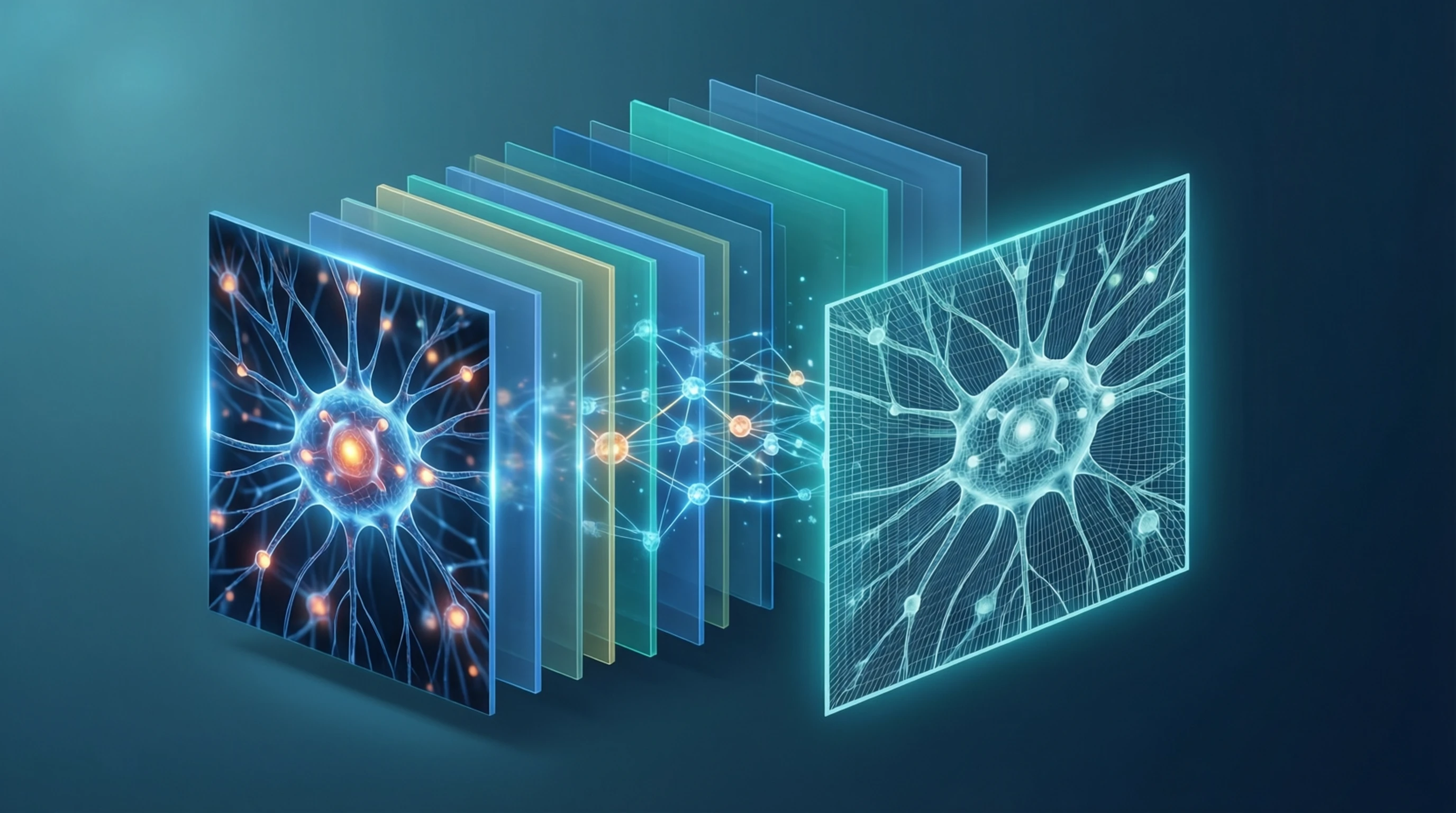
How BiRefNet AI Actually Removes Backgrounds: The Technology Explained Simply
How BiRefNet AI Actually Removes Backgrounds: The Technology Explained Simply
You upload a photo. Two seconds later, the background is gone, and your subject is cleanly extracted with every strand of hair intact. It feels like magic. But behind that seamless experience is a remarkable piece of artificial intelligence called BiRefNet -- the Bilateral Reference Network. It represents one of the most significant advances in image segmentation, and it is the engine powering the background removal tool at remove-backgrounds.net.
In this guide, we are going to pull back the curtain on how BiRefNet actually works. You do not need a computer science degree to follow along. We will use plain language, clear analogies, and straightforward explanations to walk through the technology that makes instant, precise background removal possible.
What is BiRefNet?
BiRefNet stands for Bilateral Reference Network. It is a deep learning model designed specifically for high-resolution dichotomous image segmentation -- which is a technical way of saying it separates images into exactly two parts: the thing you want to keep (the foreground) and everything else (the background).
Developed by researchers aiming to push the boundaries of segmentation accuracy, BiRefNet introduced a novel approach to how neural networks understand and process images. Instead of analyzing an image at just one scale, it simultaneously references both fine-grained details and broad contextual information. This bilateral reference mechanism is what gives the model its name and its edge over previous architectures.
Think of it this way: if older models were looking at a photograph through either a magnifying glass or from across the room, BiRefNet is doing both at the same time and combining what it learns from each perspective.
A Brief History: From Manual Tools to AI Segmentation
To appreciate what BiRefNet achieves, it helps to understand how we got here.
The Manual Era
For decades, removing backgrounds from images meant painstaking manual work. Designers in Photoshop would spend 15 minutes to an hour per image using tools like the Pen Tool, Magic Wand, or Lasso Tool. Complex subjects -- a person with curly hair, a tree with thousands of leaves -- could take even longer. The results depended entirely on the skill and patience of the editor.
Early Automated Approaches
The first wave of automation came with color-based methods like chroma keying (green screen technology) and basic thresholding algorithms. These worked only under controlled conditions: uniform backgrounds, strong contrast between subject and background, and simple edges. Real-world photos with complex, cluttered backgrounds remained a challenge.
The Deep Learning Revolution
Everything changed when deep learning entered the picture. U-Net (2015) introduced the encoder-decoder architecture that became the foundation for image segmentation. The model could learn to identify object boundaries from training data rather than relying on hand-crafted rules.
From there, a series of increasingly capable architectures emerged:
- U2-Net (2020): Added nested U-structures for richer multi-scale features
- IS-Net (2022): Improved accuracy on complex salient objects
- MODNet (2022): Optimized for real-time matting of human subjects
- BiRefNet (2024): Introduced bilateral reference for state-of-the-art precision
Each generation brought meaningful improvements in accuracy, speed, and edge quality. BiRefNet represents the current pinnacle of this evolution.
How BiRefNet Differs From Older Models
Before BiRefNet, models like U2-Net, IS-Net, and MODNet each had strengths, but also clear limitations.
U2-Net was a breakthrough in its time. Its nested architecture captured features at multiple scales, making it good at identifying salient objects. However, it struggled with fine boundary details -- hair edges often looked choppy, and semi-transparent areas were frequently misclassified.
IS-Net improved accuracy on salient objects by incorporating intermediate supervision, but it still processed information in a predominantly top-down manner, sometimes losing critical edge details by the time the model reached its final output.
MODNet was fast and handled human subjects well, but it was specifically optimized for portraits and could underperform on non-human subjects like products, animals, or objects with irregular shapes.
BiRefNet addresses these limitations by fundamentally rethinking how the model references information during processing. Rather than relying on a single pathway from input to output, it maintains bilateral references -- two complementary streams of information that talk to each other throughout the entire process. This means fine details are never lost, and big-picture context always informs the final mask.
The result is a model that handles hair, fur, semi-transparent objects, and complex edges with noticeably greater precision than its predecessors.
The Architecture Explained Simply
Let us walk through how BiRefNet processes an image, step by step. We will keep the technical jargon to a minimum and focus on building a clear mental model of what happens under the hood.
Step 1: The Encoder -- Breaking Images Into Features
When you upload a photo, the first thing BiRefNet does is pass it through an encoder. Think of the encoder as a series of increasingly abstract "observation stages."
At the earliest stage, the model notices very basic things: edges, color gradients, and simple textures. This is similar to how your eye first notices the outline of objects before recognizing what they are.
As the image passes through deeper layers of the encoder, the observations become more sophisticated. The model starts recognizing shapes, patterns, and eventually semantic concepts -- it understands that a collection of pixels forms a face, a hand, a shoe, or a tree trunk.
Each layer produces what is called a feature map: a representation of the image that captures a specific level of detail. Early feature maps are high-resolution and capture fine details. Deeper feature maps are lower-resolution but capture high-level understanding of what is in the image.
An analogy: imagine describing a photograph to someone. First you might say "there are dark lines near the center" (edges). Then "those lines form the shape of a person" (shapes). Then "the person is wearing a red jacket and standing in a park" (semantics). The encoder produces all of these descriptions simultaneously.
Step 2: Bilateral Reference -- The Key Innovation
Here is where BiRefNet does something genuinely different from older architectures.
In a traditional model, information flows in one direction: from the encoder (which breaks down the image) to the decoder (which builds the mask). The problem is that by the time high-level understanding reaches the decoder, many fine details from the original image have been lost through compression.
BiRefNet solves this with its bilateral reference mechanism. The model maintains two parallel streams of information:
- The detail stream: Preserves fine-grained, high-resolution features -- every edge, every hair strand, every subtle texture boundary.
- The context stream: Captures the big-picture understanding -- where the subject is, what it is, and how it relates to the background.
These two streams continuously exchange information with each other. The detail stream tells the context stream "there are fine hair strands here that should not be ignored." The context stream tells the detail stream "those fine lines are part of a person's head, so they belong to the foreground."
The painting analogy: Imagine you are trying to trace the exact outline of a subject in a painting. If you stand very close, you can see every brushstroke and fine detail, but you might lose track of the overall shape. If you stand far away, you see the full composition clearly but miss the fine details. BiRefNet is like having two people working together -- one standing close and one standing far away -- constantly communicating to produce a perfect outline that is both accurately shaped and finely detailed.
This bilateral communication is what allows BiRefNet to produce masks that are both globally correct (the overall shape is right) and locally precise (the edges are clean and detailed).
Step 3: The Decoder -- Building the Mask From Coarse to Fine
After the bilateral reference module has done its work, the decoder takes over. Its job is to build the final segmentation mask -- a pixel-by-pixel map that says "foreground" or "background" for every point in the image.
The decoder works in a coarse-to-fine manner. It starts with a rough, low-resolution outline of where the subject is. Then, guided by the bilateral reference information, it progressively adds detail. Each stage doubles the resolution and adds finer boundary information.
Think of it like sculpting. You start with a rough block that has the basic shape. Then you carve out major features. Then you refine the details. And finally, you polish the surface. The decoder follows this same progression, starting with "the person is roughly in the center of the image" and ending with "here is the exact boundary around every hair strand."
Step 4: Edge Refinement -- The Secret to Clean Hair and Fur
One of BiRefNet's most impressive capabilities is its edge refinement. This is the reason it can cleanly separate fine hair strands, animal fur, feathers, and semi-transparent elements from the background.
Traditional models often produce masks with jagged or overly smooth boundaries around complex edges. This happens because the model either lacks the resolution to capture fine details or over-smooths boundaries to avoid noise.
BiRefNet's edge refinement works by paying special attention to boundary regions. The model identifies areas where the transition between foreground and background is ambiguous or complex, then applies additional processing specifically to those regions. It considers:
- Local contrast: How different are the foreground and background pixels in this area?
- Edge continuity: Does this edge connect logically to neighboring edges?
- Semantic context: Should this area be foreground based on what the model understands about the object?
The result is edges that look natural and clean, even in the most challenging scenarios. Hair looks like hair, not a blocky approximation. Fur retains its softness. Transparent elements like glasses or veils are handled with appropriate partial transparency.
Why "Bilateral Reference" Matters
The bilateral reference mechanism is not just a technical novelty. It solves a fundamental problem in image segmentation that plagued earlier models: the detail-context tradeoff.
In most neural networks, there is an inherent tension between capturing fine details and understanding big-picture context. High-resolution feature maps contain precise boundary information but lack semantic understanding. Low-resolution feature maps understand the scene but have lost spatial precision.
Previous models tried to bridge this gap with skip connections (U-Net's approach) or nested architectures (U2-Net's approach). These helped, but they were essentially patching the problem rather than solving it fundamentally.
BiRefNet's bilateral reference addresses the root cause. By maintaining two dedicated streams that continuously communicate, it ensures that neither details nor context are ever sacrificed. Every decision the model makes is informed by both perspectives simultaneously.
This is why BiRefNet consistently outperforms older models on boundary quality metrics -- the measurements that specifically evaluate how clean and accurate the edges of the segmentation mask are.
Training Data: How the Model Learns
BiRefNet, like all deep learning models, learns from data. During training, the model is shown millions of images paired with their ground truth masks -- precise, human-annotated labels that mark every pixel as foreground or background.
The training process works through supervised learning. The model processes an image, produces its best guess at a mask, then compares that guess to the ground truth. The difference between its prediction and the correct answer is calculated as a loss, and the model adjusts its internal parameters to reduce that loss. This cycle repeats millions of times across the entire training dataset.
The quality and diversity of training data is critical. BiRefNet was trained on datasets that include:
- People in countless poses, clothing styles, and hairstyles
- Animals with various fur types, feathers, and body shapes
- Products of all kinds against diverse backgrounds
- Natural objects like plants, trees, and flowers
- Complex scenes with overlapping objects and cluttered backgrounds
This diverse training is what gives the model its versatility. It has seen so many different types of subjects and backgrounds that it can generalize effectively to new images it has never encountered before.
Zero-Shot Capability: Why It Works on Images It Has Never Seen
One of the most remarkable properties of BiRefNet is its zero-shot capability. This means the model can accurately segment images of subjects it was never explicitly trained on.
How is this possible? During training, BiRefNet does not just memorize specific images. Instead, it learns general principles about what constitutes a foreground subject and what constitutes a background. It learns about edges, textures, depth cues, color relationships, and semantic patterns.
When you upload a photo of, say, a handmade ceramic mug against a kitchen counter, the model has probably never seen that exact mug before. But it has learned what solid objects look like, how edges behave at object boundaries, and how to distinguish a discrete subject from its surroundings. It applies these learned principles to produce an accurate mask for any new image.
This zero-shot generalization is what makes BiRefNet practical as a production tool. It does not need to be retrained for every new category of image. It simply works -- across the remarkable diversity of images that users bring to it.
Performance: Accuracy, Speed, and Edge Quality
BiRefNet consistently ranks among the top models on standard segmentation benchmarks. Here is how it compares to older architectures:
| Metric | U2-Net | IS-Net | MODNet | BiRefNet |
|---|---|---|---|---|
| Overall Accuracy | Good | Very Good | Good (portraits) | Excellent |
| Edge Quality | Moderate | Good | Good | Excellent |
| Processing Speed | Moderate | Moderate | Fast | Fast |
| Subject Versatility | Good | Good | Limited | Excellent |
| Fine Detail Handling | Moderate | Good | Moderate | Excellent |
The most notable improvement is in edge quality. On benchmark datasets with challenging boundaries (hair, fur, lace, transparent objects), BiRefNet outperforms previous models by a significant margin. This translates directly to better results for end users.
Processing speed is also competitive. Despite its more sophisticated architecture, BiRefNet runs efficiently on modern GPU hardware, delivering results in just a few seconds per image.
GPU Acceleration: Why Specialized Hardware Matters
BiRefNet, like most deep learning models, runs on GPUs (Graphics Processing Units) rather than standard CPUs. This is not an arbitrary choice -- it is a fundamental requirement for practical performance.
A single forward pass of BiRefNet involves billions of mathematical operations. These operations are highly parallelizable -- meaning thousands of calculations can happen simultaneously rather than one after another. GPUs are designed for exactly this kind of workload. While a CPU might have 8 to 16 cores, a modern GPU has thousands of cores optimized for parallel computation.
On a GPU, BiRefNet can process an image in 1 to 3 seconds. On a CPU, the same operation might take 30 seconds to several minutes. For a production service handling thousands of images per day, GPU acceleration is what makes real-time processing feasible.
At remove-backgrounds.net, we run BiRefNet on cloud GPU infrastructure to ensure every user gets fast, consistent results regardless of how many people are using the service simultaneously.
Real-World Applications Beyond Background Removal
While background removal is the most visible consumer application of image segmentation, the underlying technology has far-reaching impact across many fields.
Medical Imaging
Segmentation models similar to BiRefNet are used to identify tumors in MRI scans, segment organs in CT images, and analyze cellular structures in microscopy. Precise boundary detection -- the same capability that cleanly separates hair from a background -- is critical for accurate medical diagnosis.
Autonomous Driving
Self-driving vehicles use image segmentation to understand their surroundings in real time. Pedestrians, other vehicles, road signs, lane markings, and obstacles must all be precisely identified and localized. The accuracy and speed requirements are even more demanding than background removal.
Video Editing and Visual Effects
Real-time segmentation enables features like virtual backgrounds in video calls, live-streaming overlays, and visual effects in film production. BiRefNet's architecture has influenced models optimized for video, where temporal consistency (smooth results across frames) adds an additional challenge.
Augmented Reality
AR applications need to understand the 3D structure of scenes and accurately overlay digital content onto the real world. Image segmentation is a foundational component of this pipeline.
Agriculture and Environmental Monitoring
Satellite and drone imagery analysis uses segmentation to map crop health, detect deforestation, and monitor environmental changes. The ability to accurately segment at high resolution directly impacts the quality of these analyses.
The Future of Image Segmentation AI
Image segmentation is advancing rapidly, and several trends point to where the technology is heading.
Real-time video segmentation is becoming increasingly practical. Models are being optimized to process 30 or more frames per second, enabling live background replacement without green screens.
3D-aware segmentation is emerging, where models understand not just the 2D boundaries of objects but their three-dimensional structure. This will enable more realistic compositing and editing.
Interactive segmentation is improving, where users can guide the AI with simple clicks or strokes to refine results for edge cases. The combination of AI speed with human judgment produces results that neither could achieve alone.
Smaller, faster models are being developed through techniques like knowledge distillation and architecture optimization. The goal is to bring BiRefNet-quality results to mobile devices and edge hardware without requiring cloud GPU infrastructure.
The trajectory is clear: segmentation models will continue to get more accurate, faster, and more accessible. What takes seconds today will take milliseconds tomorrow, and quality will continue to improve.
How remove-backgrounds.net Uses BiRefNet
At remove-backgrounds.net, we have built our entire background removal pipeline around BiRefNet. Here is how the process works when you use our tool:
- Upload: You upload your image through our web interface. The image is resized to an optimal processing resolution on the client side to ensure fast uploads.
- Inference: Your image is sent to our GPU-accelerated backend, where BiRefNet analyzes it and generates a precise segmentation mask. This typically takes 2 to 3 seconds.
- Mask delivery: The segmentation mask is sent back to your browser.
- Client-side processing: Your browser applies the mask to the original full-resolution image using the Canvas API. This means your final output retains the full quality of your original photo.
- Download: You download the result as a high-quality PNG with a transparent background.
This architecture ensures that your images are processed quickly, your original quality is preserved, and your data stays private. We do not permanently store your images -- they are processed and then cleared.
We chose BiRefNet over alternative models because of its superior edge quality and versatility across different types of subjects. Whether you are removing the background from a product photo, a portrait, a pet photo, or a complex scene, BiRefNet delivers consistently clean results.
Frequently Asked Questions
What does BiRefNet stand for?
BiRefNet stands for Bilateral Reference Network. The "bilateral reference" refers to the model's ability to simultaneously process fine-grained details and high-level context through two complementary information streams, producing more accurate segmentation masks.
Is BiRefNet better than Photoshop for background removal?
For most use cases, yes. BiRefNet processes images in seconds with consistent quality, while manual Photoshop editing can take minutes to hours and depends heavily on the editor's skill. For complex edges like hair and fur, BiRefNet often produces cleaner results than manual selection tools. However, professional designers may still prefer manual control for highly specialized or artistic work.
Does BiRefNet work on all types of images?
BiRefNet is trained on diverse datasets and works well across a wide range of subjects including people, animals, products, vehicles, plants, and more. Its zero-shot capability means it generalizes effectively to subjects it was not explicitly trained on. Extremely challenging cases -- like camouflaged subjects or images with very low contrast between foreground and background -- may occasionally require manual refinement.
Why does the tool need GPU hardware?
BiRefNet performs billions of mathematical calculations for each image. GPUs contain thousands of parallel processing cores that can execute these calculations simultaneously, reducing processing time from minutes to seconds. Without GPU acceleration, real-time background removal would not be practical.
How does BiRefNet handle transparent or semi-transparent objects?
BiRefNet can detect and appropriately handle semi-transparent elements like glass, veils, and thin fabrics. The bilateral reference mechanism helps the model distinguish between true background regions and semi-transparent foreground elements by considering both local appearance and global context. The result is more natural-looking segmentation of these challenging areas.
Will the technology continue to improve?
Absolutely. Research in image segmentation is advancing rapidly. Future models will likely be faster, more accurate, and capable of running on mobile devices. We continuously evaluate new models and will upgrade our pipeline whenever a meaningful improvement becomes available, ensuring our users always benefit from the latest advances.
Try AI-Powered Background Removal Now
Understanding the technology is interesting, but experiencing it is better. BiRefNet delivers the kind of background removal quality that was impossible just a few years ago -- clean edges, fast processing, and results that work across virtually any type of image.
Upload your image and see BiRefNet in action. No account required, no watermarks, and no cost. Just fast, precise, AI-powered background removal.